
158.1K
Downloads
194
Episodes
The Echoes of War Podcast covers military history from antiquity to the modern age.
Episodes
Jul 12, 2024
Jul 12, 2024
1hr 34 min
Jul 5, 2024
Jul 5, 2024
1hr 6 min
Craig and Gaurav discuss some of the underrated moments of WW2.
Moments like the D-Day Landings at Normandy tend to take the limelight away from other events. Such was the case when it came to two operations that were linked to Operation Overlord.
The first underrated operation Craig and Gaurav talk about is Operation Shingles, the amphibious assault of Anzio during the Italian Campaign. It was a poorly planned and faulty operation designed to defeat the Gustav line, but did end up seeing the capture of Rome.
The second underrated operation Craig and Gaurav talk about is Operation Dragoon, the landings in Southern France. The operation was supposed to be performed simultaneously with D-Day, but ended up being delayed until August.
Lastly Craig and Gaurav talk about logistics during WW2, specifically in regards to the North African Campaign. The battle against the desert fox was one of the greatest examples of how logistics win wars.
Jun 28, 2024
Jun 28, 2024
1hr 9 min
Craig and Gaurav discuss some of the underrated moments of the Pacific War.
Events like the attack on Pearl Harbor, Midway and battle of Okinawa take most of the spotlight for the Pacific War. Other events, such as the "silent service", the submarine warfare are nearly constrained to the shadows.
In this podcast Craig and Gaurav go over the Submarine warfare between America and Japan; the New Guinea Campaign and the Soviet entry into the Pacific War in 1945.
Jun 14, 2024
Jun 14, 2024
1hr 4 min
Craig, Ian and Justin discuss some of the dumbest moments of WW2.
(Apologies on audio quality, Justin literally kicked the equalizer box)
Did you know about the American torpedo problem during the first half of WW2? Basically 10% of the mark IV/V torpedoes were actually working because of a plethora of faulty mechanisms that the US Navy simply refused to acknowledge.
Did you ever hear about Sir Winston Churchills Dieppe Raid that was a colossal failure and killed many Canadians?
Listen to us complain about Admiral Fletcher and other dumb moments of WW2 in this podcast.
Jun 6, 2024
Jun 6, 2024
49 min
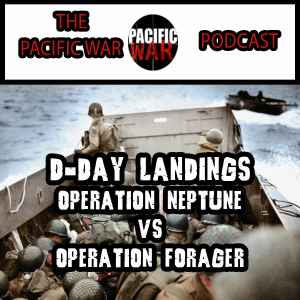
Craig and Ian discuss the D-Day landings at Normandy and compare them to the near simultaneous landings on Saipan.
Did you know while the United States participated in the D-Day landings at Normandy on June 6th, over in the Pacific another enormous amphibious assault was performed in the Marianas?
Operation Neptune, the landings at Normandy occurred nearly simultaneously with Operation Forager the amphibious assault of the Marianas. Both saw an incredible amount of men landed under fire under vastly different circumstances.
Comparing both of these operations highlights the difficulties faced in amphibious warfare, especially when colossal in size.
At Normandy the Americans landed 73,000 men (including 15,600 of airborne division), while the British and Canadians landed 83,115 men. Operation Forager's invasion force, commanded by Vice Admiral Richmond K. Turner, consisted of 127,000 troops. This means the Americans simultaneously were landing over 200,000 men in two different areas of the world!
May 31, 2024
May 31, 2024
57 min
In this episode Craig, Ian and Justin cover the differences between the battle for the Atlantic vs the Pacific.
During WW2 the Atlantic and Pacific theaters were quite different. For example, submarine warfare for both the axis and allies were dramatically different in the Pacific vs Atlantic. In the Pacific amphibious assault was mastered by the Americans, and this experience proved extremely valuable for the D-Day landings in the Atlantic. The Surface engagements in the Pacific were enormous clashes, often involving aircraft carriers, while in the Atlantic is more akin to wild hunts.
The strategy of the axis was dramatically different in both theaters, for example Nazi Germany heavily focused on submarine warfare against merchant fleets, while the Japanese initially only used their submarines against enemy warships.
Please let me know if these types of episodes are interesting to you all. Send comments over at: https://www.youtube.com/@ThePacificWarChannel
or check out the Pacific War channel discord: discord.gg/B8UwTrsysu
Don't forget I have a patreon now where you can get exclusive content like "General Kanji Ishiwara & the Mukden Incident" check it out here https://www.patreon.com/pacificwarchannel
May 24, 2024
May 24, 2024
27 min
Don't forget I have a patreon now where you can get exclusive Podcasts like "General Tomoyuki Yamashita: becoming the Tiger of Malaya" check it out here ⤵️ https://www.patreon.com/pacificwarchannel
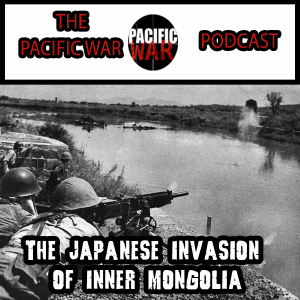
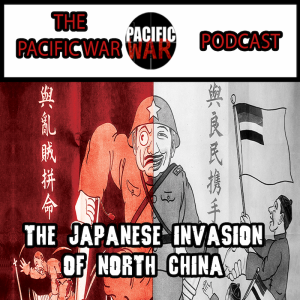
The Empire of Japan invaded Manchuria following the Mukden Incident of 1931 and established the puppet state of Manchukuo by 1933. The Kwantung Army aimed to expand their control to include the Rehe province due to its strategic and economic significance. Initially, attempts to integrate Rehe through negotiations failed, leading the Japanese to take direct action.
Field Marshal Baron Nobuyoshi Muto created a false flag operation at Shanhaiguan, then unleashed Operation Nekka, the invasion of Rehe province. After invading Rehe Muto’s forces attacked multiple entrances along the Great Wall of China, and began an advance towards Beijing. Chiang Kai-Shek was forced to negotiate a peace treaty as he was not only dealing with the Japanese, but also Chinese communists in the south. The Treaty of Tanggu that followed the invasion, de facto resulted in the Kuomintang recognition of Manchukuo, the loss of Rehe province and over 22 counties in northern Hebei.
Now the Japanese would invade Chahar and Suiyuan
May 17, 2024
May 17, 2024
26 min
Don't forget I have a patreon now where you can get exclusive Podcasts like "General Tomoyuki Yamashita: becoming the Tiger of Malaya" check it out here ⤵️ https://www.patreon.com/pacificwarchannel
The Empire of Japan invaded Manchuria following the Mukden Incident of 1931 and established the puppet state of Manchukuo by 1933. The Kwantung Army aimed to expand their control to include the Rehe province due to its strategic and economic significance. Initially, attempts to integrate Rehe through negotiations failed, leading the Japanese to take direct action.
The Japanese launched Operation Nekka on February 23, 1933, aiming to conquer Rehe and annex it to Manchukuo. This operation involved a coordinated three-pronged advance with the ultimate goal of seizing Chengde, the capital of Rehe. Japanese forces comprised the 6th and 8th Divisions, supported by puppet forces.
Despite some resistance, Chinese defenses were weak, and Japanese forces quickly advanced, taking key cities such as Kailu, Chaoyang, and Chifeng. The rapid Japanese advance led to the fall of Rehe's capital, Chengde, on March 4, 1933, as Chinese forces either surrendered or fled. The Japanese success in Rehe emboldened the Kwantung Army for further aggression.
Japanese forces quickly overwhelmed Chinese troops, pushing them to defend positions along the Great Wall and in northern Hebei province. Despite the dire situation, Chinese leader Chiang Kai-Shek prioritized combating communist insurgents in Jiangxi Province over sending reinforcements to northern China. Japanese forces, under Field Marshal Baron Nobuyoshi Muto, advanced towards the Great Wall, capturing significant areas and confronting Chinese troops in multiple battles, including Gubeikou and Nantianmen. Though the Chinese attempted to resist, their forces suffered heavy casualties, reaching around 40,000, while Japanese casualties were likely higher than the reported 2,400. The Japanese ultimately gained control of key areas, leading to the Tanggu Truce, in which China recognized Manchukuo and ceded territory. Despite the treaty, this did not mark the end of Japan's ambitions in China.
May 10, 2024
May 10, 2024
1hr 12 min
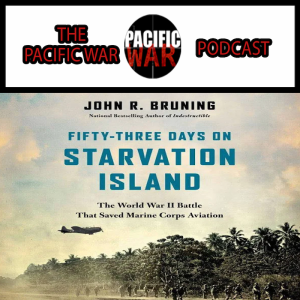
John R. Bruning is the author or collaborating writer of over 22 books such as the national bestseller Indestructible, Outlaw Platoon written with Sean Parnell, Shadow of the Sword with Jeremiah Workman, How to Break a Terrorist with Matthew Alexander, House to House with David Bellavia, The Devil's Sandbox, and Ghost: Confessions of a Counterterrorism Agent with Fred Burton.
The interview is about his upcoming book “53 days on starvation island: the world war II battle that saved marine corps Aviation”.
It is the pivotal true story of the first 53 days of the standoff between Imperial Japanese and a handful of Marine aviators defending the Americans dug in at Guadalcanal.
I can’t recommend this book enough to Guadalcanal lovers out there. The book covers the plight of the aviators on Guadalcanal. It tells the stories of the men, their hardship and endurance, it's really awe inspiring. His book comes out on May 14th, so please show some love and give it a look.
May 3, 2024
May 3, 2024
1hr 26 min
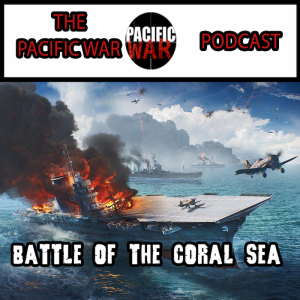
In this episode Craig and Ian cover the Battle of the Coral Sea.
The Battle of the Coral Sea, fought from May 4 to May 8, 1942, was a pivotal naval engagement between the United States and Imperial Japan during World War II. It marked the first time in history that two opposing naval forces engaged each other without the ships ever coming within sight of one another, relying solely on aircraft carriers and aircraft. The battle took place in the Coral Sea, northeast of Australia.
Both sides suffered significant losses in terms of ships and aircraft. The Japanese aimed to capture Port Moresby in Papua New Guinea, which would have provided them with a strategic foothold to threaten Australia. However, their plans were thwarted by Allied intelligence, allowing the American and Australian naval forces to intercept the Japanese fleet.
The battle resulted in a tactical victory for the Japanese, as they sank more Allied ships than they lost. However, it was a strategic victory for the Allies, as they successfully prevented the Japanese from achieving their objective of capturing Port Moresby. The Japanese carrier Shoho was sunk, and the larger carrier Shokaku was damaged, which hindered Japanese operations in the Pacific theater.
Both sides suffered heavy casualties, with the USS Lexington and the Japanese carrier Shoho being sunk, and several other ships damaged on both sides. The Battle of the Coral Sea demonstrated the importance of naval air power and marked a turning point in the Pacific War, as it halted Japanese expansion and set the stage for the Battle of Midway.